If you’ve never seen haskap before, this whole article is going to seem very strange to you. So before I go and tell you what haskap is, let me show you what haskap looks like.
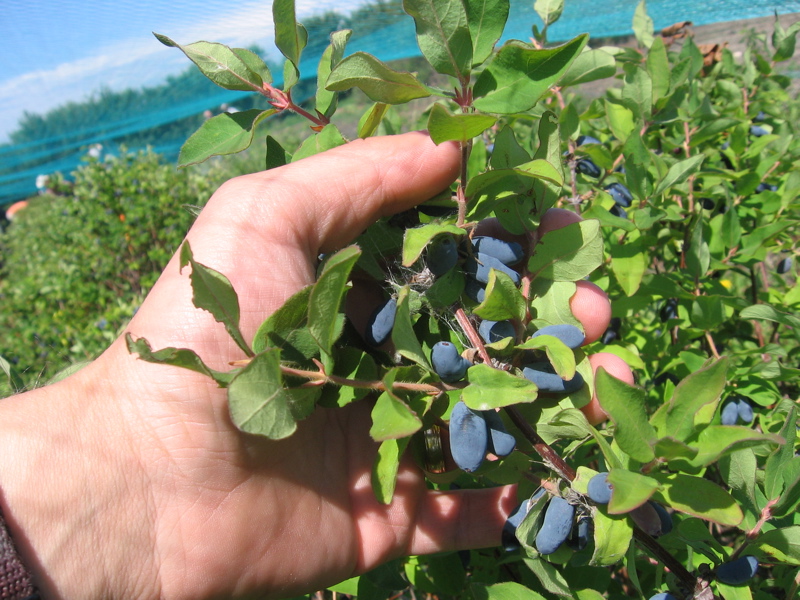
What is Haskap?
Haskap is an amazingly hardy, fast growing, high yielding, great tasting berry bush that is relatively new to North America. It is an edible honeysuckle that originates from Siberia and can be found in Russia, China, and Japan. It goes by the name ‘Honeyberries’, ‘Blue Honeysuckle’, and ‘Haskap’. Recently, it has been developed at the University of Saskatchewan by Dr. Bob Bors for commercial production.
What makes Haskap so remarkable?
Haskap has several features that make it stand out from among all other fruits.
#1. Hardiness
Coming from Siberia, it is extremely hardy. It can withstand winter temperatures of -47° Celsius. Not only that, but its open flowers can endure -7° Celsius. They are the earliest to fruit in the season, usually in mid to late June – even earlier than strawberries.
#2. Early & High Yield
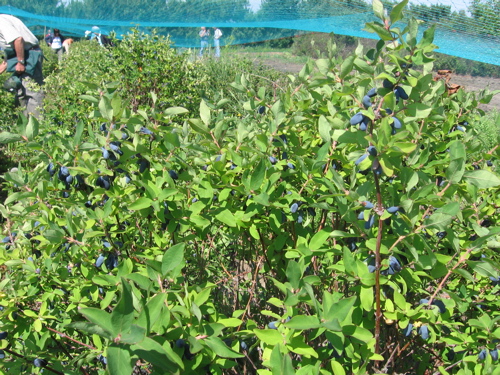
One of the greatest thing about Haskap is that it doesn’t take seven years to start producing. My seedlings were planted in the spring of 2006 and I ate my first fruit in June 2007. In the studies at the University of Saskatchewan, they were yielding 1 kg (2.2 lbs.) per plant in their 3rd year and 4 kg per plant in their 6th year. The picture below is a three-year old plant in the test patch at the University of Saskatchewan.
#3. Unique Flavor
Haskap is unlike any other fruit you’ve tried. Some have compared it’s taste to blueberries, raspberries, blackberries, rhubarb, saskatoons, and black current. The flavor seems to vary with varieties. They are most often compared with blueberries, but without the seeds. The seeds are similar to that of kiwis, so you don’t even notice them. As for it’s uses, basically anything you would do with blueberries, you could also do with haskap – eat them fresh, in baking, as jams & jellies, frozen, or whatever else you may think of.
You can learn more about Haskap by visiting these sites:
Or you can buy Haskap plants from DNA Gardens in Elnora, Alberta.
Edited: June 1, 2008
Read more in my post Haskap Blossoms In May or Early Haskap Berries.
236 replies on “Introduction to Haskap Berries (aka Honeyberries)”
Our haskap harvest was sad this year! But I understand other haskap growers had the same issues.
Mine had few berries this year (2016) either. I am near St. Paul, MN.
2016 was good in Calgary, the Spring was a month early, we had fruit in the first week of June. I had enough berries for two batches of freezer jam from 4, 8 year old plants.
2017 – the flowers are just out (May 9 and the bumble bees are busy, lots of flowers this year.
I just bought two varieties of Drarf sour cherries from the U of Sask series. (Romeo and Crimson) I hope they do well.
I have trimmed some wild branch’s on a bush.
Is there a way to get them to root and grow?
Joe L: I haven’t tried it myself, but you can try to dip the end in a rooting solution/powder and then pot it up!
Could a honeyberry plant cross pollinate with a blueberry plant? Thanks in advanced
Sunshine: Nope – sorry. They are two different species.
Does anyone have a hasp berry jam recipe?
I bought a single honeyberry from walmart today not knowing they needed to cross pollinate with another type of honeyberry. I have two different types of blueberry including a pink lemonade. Is there a chance that the three can cross pollinate? I am running out of space to put another one in.
Al: Nope – sorry. Blueberries and honeyberries are two different species.
Where can one purchase picked honey berries? I heard about this fruit recently and after reading about it found it interesting but would like to try this unique product.
Mike: There are more and more growers popping up all over Canada and the US. You could try a local u-pick farm or there may be some at your local farmer’s markets.
We bought two small Haskap bushes about 12 years ago on the premise they were a sweet berry. False advertising I think.Big disappointment when berries came.The taste for us was more like putting ones tongue on a dandelion stem no matter what time we picked. We still have some on now in August and still sour. For 11 years the birds have still been feasting on them so guess the $15 each wasn’t all wasted, however they are taking up room in the garden and will be dug up this fall and shredded.
Do you know where I can buy honeyberry plants in Calgary? I’m looking for Boreal Blizzard and Boreal Beast types. Thanks!
Tracy – I don’t have any specific stores in mind right now, but they are becoming increasingly popular. In the spring you should be able to find several varieties in most garden centers.
I saw some established (already flowering) plants in a Home Depot Garden Center, they’re $13 a pop. Or you can get some younger plants from Walmart Garden Center where they sell a young Honeyberry plant for $9. Make sure you get different varieties for pollination though.
Found some in Canadian Tire too.
I just picked up a couple bushes from Golden Acres and they had more in stock.
You might want to try Blue Grass Nursery out by Cross Iron Mills. That is where I bought mine about 3 years ago.
Hi Tracy, I bought mine a few years ago at the Saskatoon Farm in Okotoks. I’m pretty sure you can still get them there.
Saskatoon farms
Whiffletree Farm in Elora, Ontario will send bare root plants and I believe they have these varieties.
Is it more shrublike or vinelike? My other honeysuckle is certainly a climber.
I have two haskap berries and they are fruiting OK. I need to transplant them. They are about 2 years old. I have a spot picked out. But it is May 7 here in AK. Bare ground. Some warm days. What temperature should the ground be before I transplant? They are going from one raised bed into flat ground. Any suggestions welcome. Thank you.
Hi Tracy, I bought mine a few years ago at the Saskatoon Farm in Okotoks. I’m pretty sure you can still get them there.
We have 11 plants that are very well established. However, 4 of the bushes that were purchased have very bitter sœur berries. The other plants taste excellent and grow differently than the 4 gross ones. Can anybody explain why?
Corry – I presume the four are a different (and likely older) variety. Newer varieties have been developed over the past couple decades and they are significantly better than the originals.
H.i have been growing and sellin these gems since 2014 .Some are loaded and some are not i do beleive deer love the buds in late winter so beware .
Has anyone ever tried to cover the Haskap to keep birds off of them? I tried this year but what looked like a bumper yield turned out a failure.
Guy: Yes, I’ve covered mine and it worked very well – although I did find and cut free a cedar waxwing that got itself caught in my netting. What type of netting did you try?
Just moved to Alberta from Saskatchewan – miss my berry bushes ?? Can you grow these & other Berries in Medicine Hat, AB? I don’t see a lot of berries here?. Thanks Maureen
I have a south facing backyard and a front North yard. On the tag it says sun-shade? If I plant in the backyard it will certainly get ALL day sun…hot ?. Or should I plant with some sun in morning and late afternoon? Even in the winter the sun melts our snow in Crossfield which is 30 mins north of Calgary Alberta. Please advise
Darlene: given a choice, most fruit bushes would do better with more sun than shade. Most haskap orchards have their bushes in the open field (sun all day!) It might be a bit hot if they are up against a wall or fence or something that will reflect and intensify the heat, but if you can avoid that and make sure they have lots of water, they should be ok in the backyard. Haskaps are crazy hardy! Their flowers can withstand -7, so even your Chinook’s shouldn’t kill them!
Sweet, I’ll have to take pictures and post them, looking forward to using these fruits in our recipes in our small bistro in Carstairs Alberta called Olifunt Espresso & Wine Bistro.
I bought a plant at Walmart not realizing I need 2 different varieties but I am not sure what type I got l. Is there any ways to tell?
Cagney: That’s a tough one. You might be able to make some educated guesses with a careful examination of the plant structure and the berry shape/size – but that’ll probably take a few years! But as small, young plants, I don’t think I could tell the difference between varieties! Sorry! If you have space, maybe you want to buy two more plants (different varieties) so you’ll have at least one different one!
Is this a naturally occurring plant/shrub, or has it been genetically “created” by man? I see that it seems to have originated from the University of Saskatchewan.
Haskap is very much a naturally occurring plant – you can find it growing in the wild in places like Canada or Russia. The work done at the University of Saskatchewan was done by selective breeding – that is, propagating the plants that had the most desirable traits (best tasting, larger size berries, etc..) So the plants you buy today are the same plant as found in the wild, but are ‘the best versions of themselves’.
very promising plant with delicious berries. Will find out if they make good wine too
Hi Haskap people. I have 3 different varieties( don’t recall names) that I planted several years ago. Finally this year, for the first year, I have one plant that has flowered and is producing small fruit. Sadly, as I other years, some of the leaves have begunturning yellow and diseased. No bugs evident, but looks maybe systemic. Tried to attach a photo, but not accepting. Any ideas??
Do you require a male and female plant to grow haskaps? I have three different varieties and small little white berries grow but do not grow to maturity? Also, what is the best soil to plant haskaps in? Thank you.
Datlene: You don’t need male & female plants, but you do need at least two different varieties to pollinate. However, if you have white berries, I suspect you don’t have haskap at all! Haskap berries will be green to begin with and will eventually turn a deep purple.
Our landscaper planted both a polar jewel and a tundra this year in May. We soon got a few lovely berries on both. The plants are against the house, face west, so lots of afternoon heat. Some leaves, especially on the polar jewel are drying out in the middles, turning brown/gold. What is happening, and what do we need to do? With thanks and appreciation for your time.
Federated Co Op stores sell a haskap ice cream…..delish! Its uncommon but sometimes available here in Fort Saskatchewan Alberta