For my family, and I imagine many other North Americans, potatoes are the most common food eaten in our home. Whether it’s mashed, baked or boiled, or made into french fries, hashbrowns or chips, we eat potatoes almost daily. It’s no wonder that nearly every vegetable garden has at least a few hills of those wonderful, all-purpose tubers. My complaint comes when you dig up your spuds in the fall, and they’re covered in ugly, brown scabs.
In 2006 I grew the scabbiest potatoes I had ever seen. They were covered with about a 1/4 inch of scab from top to bottom. I couldn’t even use a regular peeler to peel them – I had to cut the skin off with a knife. They were terrible. The inside still tasted fine, but who wants to deal with 1/4 inch of scab?
So that winter I searched the internet and asked the advice of more experienced gardeners – namely my parents – and got some really easy to follow suggestions. Then, following that advice in 2007, I grew the biggest, scab-free potatoes I had ever grown. Want to know how I did it? Here’s what you need to do:
#1. Choose A Scab-Resistant Variety of Potato
Some potato varieties are more resistant to scab than others. In Alberta, some of the common varieties that are most resistant to scab are Cheiftan, Norland, Viking, Gold Rush, and Russet Burbank. Two common types that are susceptible to scab are Red Pontiac and Yukon Gold.
#2. Rotate Your Crops Year By Year
This is a good practice for all of your vegetables. This may not be much help in a plot that consistently has problems with scab, but planting in the same location year after year will certainly encourage it.
#3. Keep Your Potatoes Well Watered Once The Plants Have Flowered
While your potato plants are flowering, the tubers are developing. Previously, I had never watered my vegetable garden unless it had been very dry for a long time. In 2007, I set my water sprinkler in the garden and watered my potatoes once every three days. I believe this was the biggest contributing factor to the large, scab-free potatoes that I enjoyed that year.
Give it these tips a try and let me know what happens!
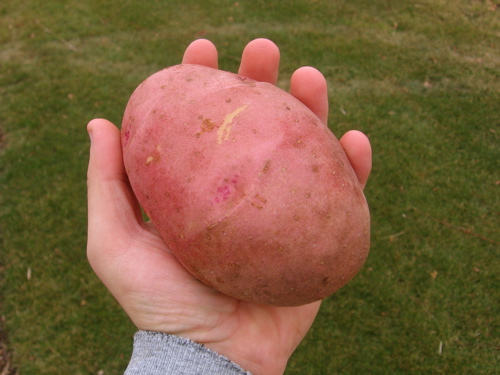
This is a Viking variety potato grown in 2007
(For another photo, see “What’s the Deal with this Blog?“)
20 replies on “How To Grow Amazing Scab-Free Potatoes”
I’ve enjoyed reading your article on square foot gardening. I have
2 perrenial flower beds in my yard right now, and am considering doing
a square foot garden this year. I was wondering if you can use the
same soil for annual flowers in pots? What would you add to amend
your soil where the perrenials are? My neighbour says he uses mushroom manure every year and that’s it.
Absolutely! This soil can be used anywhere. Right now I’ve got seedlings started indoor that are in that soil mix. I find it doesn’t dry out nearly as fast as regular potting soil.
To amend your soil, try a variety of composts. Different composts have different amounts of different nutrients. Mixing them should balance that out a little. Another thing you may want to consider: Since adding some peat moss to my vegetable garden, I find the soil SOOO much looser and easier to weed. I would also think the roots have an easier time making their way through the soil. Hope that’s helpful!
this is very interesting. ive always wanted to know that. thanks a lot. youve helped me with my health project as well as my garden at home. im sure my potatoes will be scab free this here.
-phillip jones
do you have a remedy to keep infestation off growing turnips/rutabegas. i have been growing them to 8-10 inch in diameter but there are little white worms in them. any ideas?
I have had scab problems on my potatoes and we have new soil so crop rotation should not be the problem- I never knew lack of moisture could be the problem – I will keep them watered this year and see if it helps. Does the ph level make any difference to the appearance of scab?
From what I’ve read on the internet, it seems that ph levels lower than 5.2 should help reduce scab.
I have had scabs on my potatoes for four years I rotate garden even made a new bed this year . watering this year was no problem as we have had oodles of rain.. this year in the new bed they are worse than ever I always b]uy seed ,this year it was norland……please help
Shirley, take a look at this link http://www.uoguelph.ca/pdc/Factsheets/PDFs/119PotatoScapGarden.pdf
When do you dog your spuds? I always wait until September. I am in BC in a Zone 3 area (I go by the old zone map). I see lots of people here digging in mid August. I am wondering if the longer you leave them in the soil, the more the scab develops.
What are your thoughts on that?
I planted potatoes about 3 years ago in Calgary, and had just altered the soil with lots of compost manure. The potatoes turned out very scabby. After that I was listening the the Sunday morning Gardening show on AM-QR770 and heard the potatoes were scabby because of too much manure in the soil. I haven’t planted since, so don’t know if it was true.
James, I agree with what you heard on QR770 – too much manure will encourage scab.
Two things that will cause scab on potatoes are wood ashes and fresh manure.
For most crops, wood ashes are a good source of potassium but never put it where you plan to grow potatoes. It makes the soil somewhat alkaline and spuds like it a bit on the acid side.
POTATOE SCAB YOU NEED TO PUT SULPHER IN YOUR SOIL WILL GET RID OF POTATOE SCAB GET IT FROM FARM SUPPLY STORE OR GREEN HOUSE
Here’s some food for thought:
I’ve never had a problem with scab for 3 years. This year I tried a new variety seedling because it was “popular”. This crop of potatoes has scab. I agree with all the above mentioned about soil pH and moisture….however don’t forget about the fact that you may “introduce” it into your soil with an infected seed and certainly don’t forget that it will stay in your soil for some time.
If you want good red potatoes you need to put lots of compost in before or when you plant them and water lots, I have planted red potatoes for 15 years and we had a really wet summer one year and I had tons of big potatoes the biggest being 5Lbs 8oz. No manuer. Norland are great.
I have tried different varieties and still get scabby potatoes. My friend, who never has scabby potatoes, gave me some seed potatoes and mine turned out scabby, hers didn’t. I am going to alter the ph in the soil and see if that makes a difference
Hi, I have tried almost everything,My white potatoes get brown spots going into the potato about 1/4 ” and my red potato gets a heavy scab. They have good drainage, and lots of sun. I make my own compost from veg and fruit peelings, no meat or fat in the compost, I do not use any kind of chemicals. I buy my seed potato’s from a well known Nursery. A couple of years ago I bought straw and mixed it in the soil. What am I doing wrong
Dianne: The bacteria that causes scab is likely already in your soil. Making your soil a bit more acidic is probably the best way to fix the problem. Have a look at this link for more info: https://www.gardeningknowhow.com/edible/vegetables/potato/treating-scab-in-potatoes.htm
If you put sulfur in your garden ..will it affect the taste of the potatoe.
I’ve planted white potatoes for the last two years. Both crops have had scabs. This year is the worst. So here is my question – I have never planted in the ground,I plant them in large potato bags and every year I use clean soil with lots of sunshine and plenty of water. The only thing I can think of is that the bags are sitting on the ground, maybe transferring the spores. So I’m thinking I should use a different soil and keeping the ph better. Does anyone have any ideas? It sure would help. Thank you