One of the most valuable assets in my garden is my greenhouse. It has allowed me to grow plants that I normally would not be able to grow, produce crops that the season is not usually long enough to produce, and protect my plants from frosts, hail, or other severe weather that normally would have destroyed my garden.
But I don’t have thousands of dollars to spend on a greenhouse. I just priced out an 8’x12’ greenhouse for $3,500. I would love to have a large, professional greenhouse, but that simply isn’t financially feasible for me. So, instead I’ve found a way to make a large greenhouse that is functional, easy to build, and inexpensive. This article will explain to you exactly how to build a 12’x32’ hoop-style greenhouse for under $400.
Required Materials List
Note: All wood should be green, treated wood to resist rot. (Or you can spend more money and buy a rot resistant type of lumber such as cedar.)
- (4) 2×6 – 16’
- (2) 2×6 – 12’
- (14) 2×4 – 12’
- (19) ¾” x 20’white pvc pipe
- (9) 10mm x 10’ rebar
- (1) 20’x50’ roll of 6mm plastic
- (1) Bundle of 50 4’ wood lathe (or optional staples)
- Zip ties
- Nails or screws
- Metal banding
- Door hinges and handles
Step 1 – Laying Out the Frame
Using the 2x6s, lay out and put together your 12’x32’ frame. (You can join the two 16’ pieces with a 2’ piece of 2×4.)
Ensure that the frame is square by measuring diagonally across it. You can temporarily keep the frame in place by pounding a 30” piece of rebar in each corner. (You can pull these out to use them in the next step.)
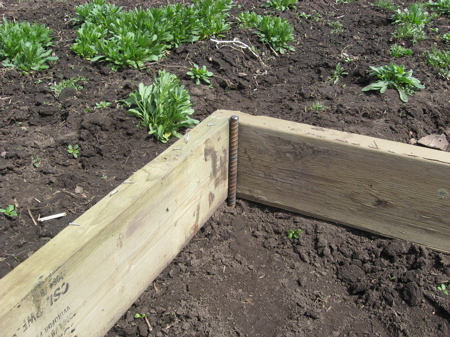
Step 2 – Adding the Hoops
Cut each 10’ piece of rebar into four 30” pieces of rebar. This will give you thirty-four pieces. Pound the rebar into the ground about 15” deep on the outside of your frame at two foot intervals. This will leave 15” sticking up out of the ground.
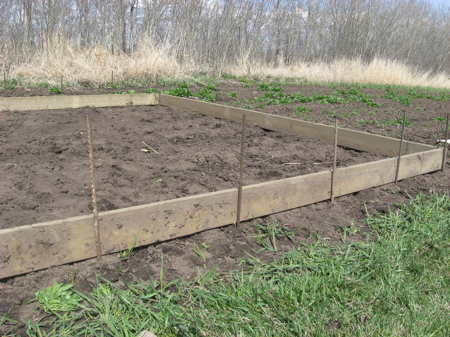
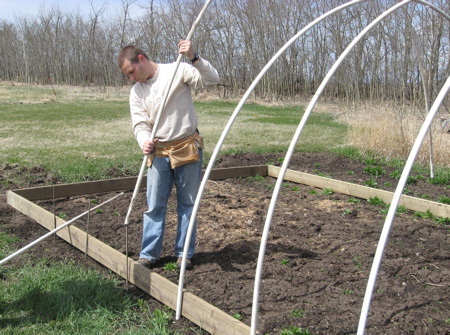
Now slide both ends of your pvc pipe over the rebar to make a hoop across the width of your greenhouse.
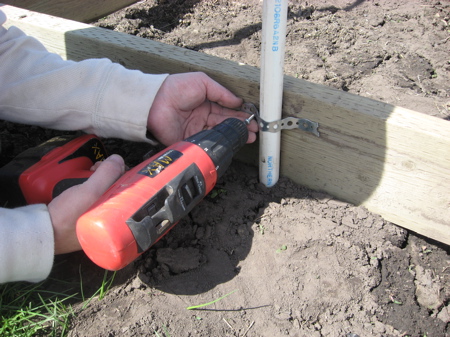
Attach the pvc pipe to the 2x6s by screwing short pieces of metal banding around the pipe.
Step 3 – Building the Ends
Cut the following pieces out of your 12’ 2x4s:
- (2) 11’8¾”
- (4) 1’6″
- (4) 4’7″
- (4) 5’7″
- (8) 1’11¼”
- (2) 4’¼”
For each end, assemble the wall according to the following diagram.
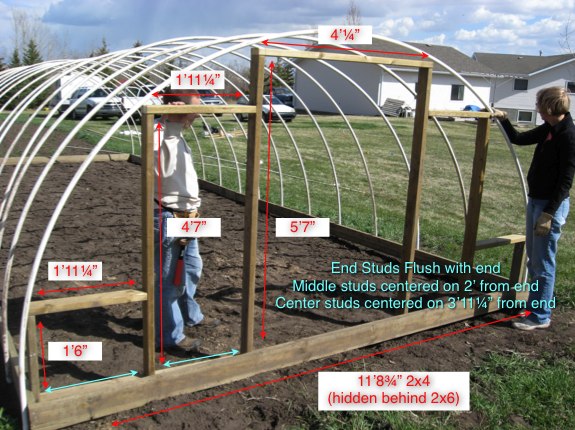
Place this wall within the 2×6 frame and nail/screw in place.
Cut (4) 28” 2×4 pieces. Cut one end at a 45º angle. Use these pieces to brace the wall.
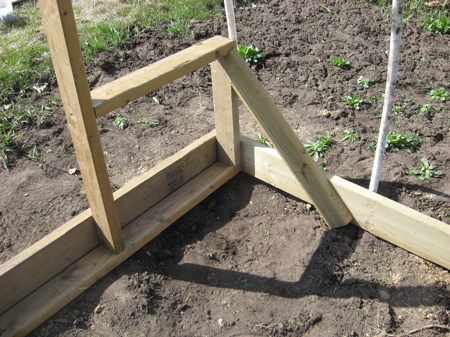
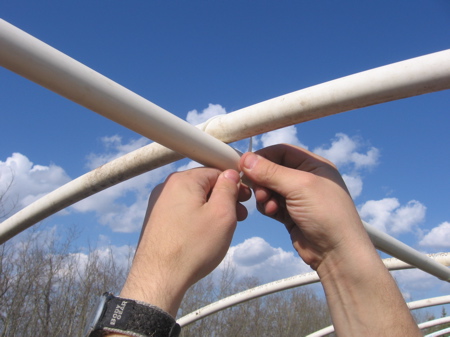
Once all of the hoops and the two ends are in place, connect two pvc pipes together and cut them to measure 32′ long. This will be the rib that will go along the top of your hoops. You can attach this rib with plastic zip ties.
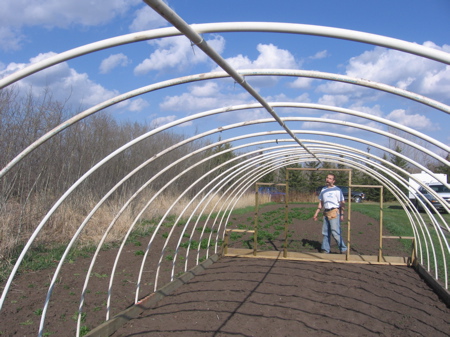
Step 4 – Covering the Greenhouse with Plastic
If you are going to use wood lathe, cut 32 pieces of 20” lathe. These will secure the plastic to the sides of the 2×6 frame in between each hoop. Or optionally, you can use staples, though they may have a tendency to pull through the plastic.
Drape the plastic over the length of the greenhouse. Be sure to have enough overlap at the ends to cover the end walls. Pull the plastic snug and attach to the 2x6s at one end using the wood lathe or staples. Go to the other end, pull snug, and attach in a similar manner. Do this at the center, and then along the rest of the length of the greenhouse.
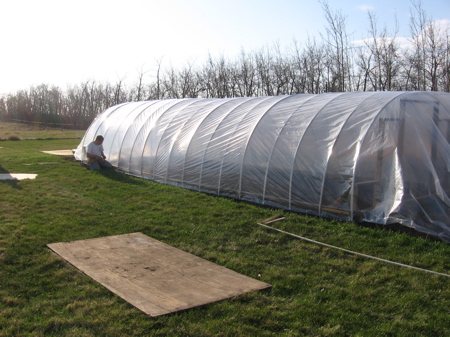
Note: If you can do this in warm weather, there will be less sagging later. Make it as snug as you can without causing damage to the plastic.
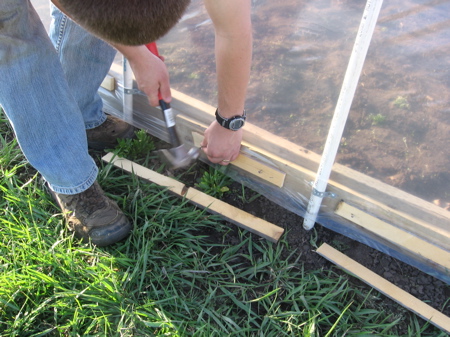
To attach the plastic to the ends, pull the plastic straight down, and attach with lathe. Then pull the plastic out to the sides. This will give you extra plastic along the outside edge. Fold the plastic back towards the center and attach. For the end with the door, cut out the plastic leaving a few inches of over hang to wrap inside and attach.
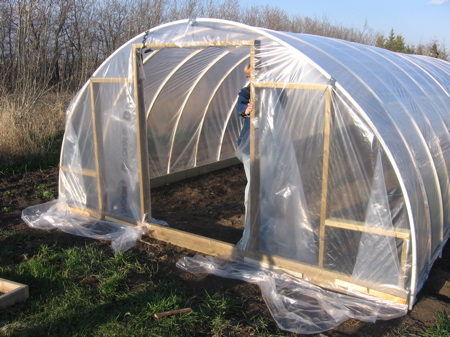
Step 5 – Adding the Door
Before you cut your pieces, check the actual measurements for the space you have. Your wall may sit a little different than mine. It’s always better to go a little small or your door may not fit. But if the measurements are the same, cut the following pieces out of your 12’ 2x4s:
- (2) 4’11”
- (2) 3’9″
Nail these together to make your door frame. Lay a 2×4 diagonally across the frame and nail in place. Trim off anything that hangs over the frame of the door. This will be on the inside of your door. Too much wood hanging over will jam your door. Attach the hinges to the door frame.
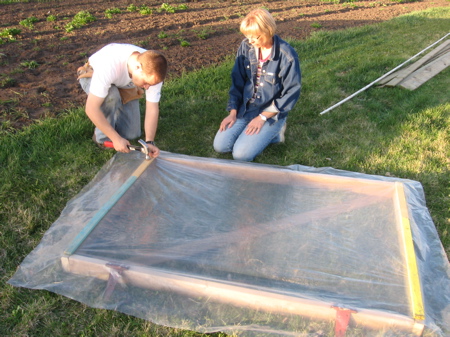
Cover the outside of the door with remaining plastic or you can use plywood if you would rather. You can attach the plastic with the wood lathe or staples. There should be about 4” of overhang of plastic on all sides.
Attach the door handles to the door. Mount the door to the frame.
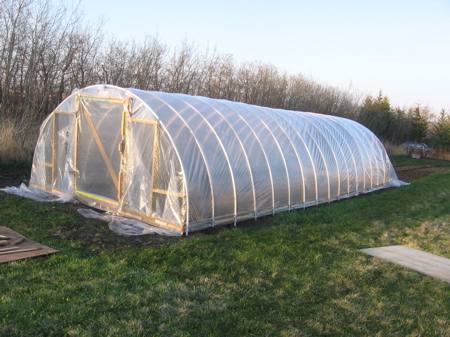
And there you go! You can have a beautiful 12’x32’ hoop-style greenhouse that can be built in a weekend and all for less than $400.
——
Update: July 11th, 2008
To see just how well this greenhouse works, see my July Greenhouse Update.
Update August 5, 2009
For an new and improved version, see An Inexpensive, Hail Proof, PVC Pipe Greenhouse.
Update November 29, 2010
Improved design. Changed material list from half inch PVC to three-quarter inch PVC.
457 replies on “How to Build an Inexpensive Hoop-Style Greenhouse”
Aahh Great info guys!
I’m planning on a start to greenhouse farming later on in the year and I can’t thank you enough for the eye-opener on a much cheaper alternative to a standard greenhouse.
I’m wondering if you could help me with establishing the measurements, materials and general info for construction of a 8×15 metre hoop house-style greenhouse. I want to put it up for And add a drip irrigation system, maybe.
Would you be my consultants? You got my email address. Hoping this is not too much to ask. Thanks a load.
Hi there;
I built my hoop greenhouse, in April 2015, here in Calgary in my backyard. It is 10 feet, by 4 feet, and stands about 4 ft tall…I got the PVC pipe in 10 foot lengths for $4.10 at Rona, the plastic I already had a roll for the insulation in the basement…pretty thick stuff too. It cost me about $30. and my garden is already up, and I would say I am about 2 months ahead of my neighbors. They all told me I was too early planting…now they are kicking their own butts..LOL My family is all looking forward to fresh veggies. We are looking at building a 2nd one for the potatoes and watermelon, so that will be next.
How are things going? hail damage? still going well? any updates. Looking to build one in Calgary Area too.
I am in Calgary, and my garden was destroyed this year with the continous hall and then finally a one hour log hail storm, so i am also considering it.
How is it resisting the winds. I’m from Lethbridge. How about ventilation?
Im not seeing at what length is the PVC pipe cut into.Could you provide me with a length anyone?
Cal: The pvc is in 20 ft lengths. (Or two 10 ft.)
lovely hoophouse! Now I want u
If you choose to use treated wood keep it away from anything you plan to eat. The wood uses very high concentrations of copper (older pressure treated also used arsenic). The plants can take up these things which you are then eating. Also, sometimes it causes stunting of the plants.
A much better option is redwood or cedar which are naturally rot and insect resistant.
im with you girl im organic with what i do ill get cedar i got alot in my front and back yard just got to cut it
It’s been proven in studies that modern pressure treated lumber is Safe for vegetable gardens.
The veggies barely take up any of the harmful chemicals and what they do, is such small trace amounts that it’s safer than eating seafood. And the human body doesn’t retain modern Pressure Treated chemicals.
Just an FYI
hehe liar you sell glomerphosates?
I used this to help me out when I put my first hoop house up back in 2012, I used galvanized 1″ water pipe instead of pvc. It has been moved twice and got a new sheet of plastic summer of 2023
Greetings from iceland
Just wondering how early you can plant in this?
Bea gee: It all depends on your climate. I can usually plant in this about a month before I plant in my garden.
Just a note. I have a huge problem with gophers, found a solution to the problem was to use plastic kiddie pools for planters box instead of the typical wood frame. This works perfectly, they don’t chew through and it actually costs less.
Hi
How do you heat your greenhouse in winter when its -30. I would like to know that please as I have an aquaponics system that I want to move it from my garage in put it in a greenhouse.
thanks
Rosh
Rosh: I don’t! I only extend my growing season by a few weeks on either end. It’s just not economical to heat throughout the winter.
It’s best to build the GH off the south side of your home and heat it that way. Build it off an existing doorway, open door for heat from the house. On sunny days the GH helps keep the house warm too. I am also using some wire fencing I have left over to reinforce the GH for when it snows. It won’t collapse that way.
Hi,
You can double your plastic and use a small blower in between the plastics. It creates a type of insulation. And it is much cheaper then any heaters.
That is a great set of plans, lots of details, a design that will be perfect for my situation in E TN. If I may offer a question/suggestion – I am thinking the re-bars ought to go inside the wooden border so that the stretched plastic will remain flush with the wooden border when tacking it in place – also, the wooden border might provide just a bit more reinforcement to the pvc pipe.
.
Also, regarding the center brace, might the installation to the outside of the ribs give just a bit more support to the plastic sheeting along the length of the house? Did you find the one length of center bracing to be enough or would an additional 2 pvc pipes maybe half way down the ribs would add a bit more stiffness to the structure?
.
I might have missed it, but what dimensions and thickness plastic sheeting did you use?
what size plastic would I need for this project? I love it and wat to build oe so I ca have my garde that deer ad critter won’t get into.
Lori: The material list includes a 20’x50′ roll of plastic. However, that is a little more than absolutely necessary. You probably want to have two feet of extra material on each edge, so for a 12×32 greenhouse, you would want your plastic to be at least 16’x36′
http://www.northerngreenhouse.com
Is a great place to get the proper covering for your green house. They also explain how to measure it for your structure. cheers
This is a great little greenhouse plastic size calculator that I have used over the years. Just type in the greenhouse dimensions, and it tells you the exact sizes of plastic needed.
This looks great. One question, how has held up to elements? (Wind, snow, etc). Also, if in a windy area, would more top ribbing (on the sides) help or would that be pointless?
Hi Denis – Since this post, I’ve updated my design a bit. You can read that here. https://www.albertahomegardening.com/an-inexpensive-hail-proof-pvc-pipe-greenhouse/ With the added features in that design, plus a 2×4 across the top with a single support pole in the center (to help hold up snow), this design holds up really well! I don’t think wind is any issue. Snow load seems to be the biggest concern. The one thing you could do to further support the snow load is to run rebar the full length inside the pvc pipes. But with the center beam like I’ve described, I don’t even think that’s necessary.
When not in use during the winter, will the greenhouse withstand heavy snow and ice?
Hi Mark – Since this post, I’ve updated my design a bit. You can read that here. https://www.albertahomegardening.com/an-inexpensive-hail-proof-pvc-pipe-greenhouse/ With the added features in that design, plus a 2×4 across the top with a single support pole in the center (to help hold up snow), this design holds up really well!
Do you have a picture of this? im trying to picture in my head but i cant.
thank you
I live on an acreage near Okotoks and I am considering building one of these. How do they stand up to the strong winds? I see them all over, so quite well I guess but in which direction should I orientate it, bearing in mind our patch of land is not well treed and sheltered yet?
Thank you for any advice.
Annie L: Yes – these greenhouses stand up quite well. Typically, an east/west orientation is the best, but you’d have to take into account the factors at your particular site like wind and shade. If you are going to be planting trees or putting up other buildings, be sure not to put your greenhouse where it will be shaded by those things.
Thank you, Dave,
I have also seen the updated version too, and have another question too please.
How do you join the seams, or what width should I order.
I have no shelter belt, and wonder whether the wind would work in and start to work gaps into the joins?
Many thanks for all your advice.
Annie L: When you order from northerngreenhouse.com, you just give them your total size and they will take care of the seams – sending you one large piece. You would have no seams to worry about. I would order a piece that is 2′ longer and 2′ wider than what your actual dimensions are. (That will give you an extra foot on each side.)
Do you have a email Dave? I appreciate your comments. And you’re education towards this subject.
Menraeil – I’ve emailed you.
Annie, I don’t know if you have built your hoop house yet , but I live south of Sylvan Lake and you need to build it considerably stronger for wind especially- side bracing etc
Edit to above,
I mean how do I join the poly woven material please.
I use the same poly supplier, great material. Built one tunnel couple year ago, now I am planning to built bigger one, but with double wall to extend the season a bit longer. Will use woven poly outside and standard plastic film 3.5 mil for inside. Wonder if anyone has attempted double wall construction for tunnel, without using blower. I ma building tunnel on top of raised bed and it will be 5′ wide,~6’toll, 15′ long. I hope 4-5″ space between layers of poly will provide extra insulation.
You say you used 3/4? white pvc @ 20? lengths. What schedule (flexibility) was the pvc, and where did you find 20? lengths – I can only find 10? lengths, which are schedule 40.
Appreciate your innovation.
Claire: Yes, I used schedule 40 pvc – and I found the 20′ lengths in a few places – co-op, UFA, and Home Depot. But 20′ lengths are much harder to find these days. (This was several years ago now.) You’ll likely have to talk to a wholesaler or plumber for the 20′.
Once again, thank you for this really helpful advice. I am feeling quite excited about building a greenhouse now. The sooner, the better!
Happy growing and best wishes
Annie
What about heavy winters and snow? I live in New York State and it gets cold and heavy snow. Will this pvc hold up to hard winters?
Thanks for knowledgeing me..
I m trying my best,
for making green house..
And onces again thank you
This sounds wonderful! Will it stay warm enough in the winter? I live in Va central, and I want to do hydropnics.
Thank-you for your time. Kat
I’ve noticed so many ppl throwing away old trampolines. The Circular type w/ 4 outside poles. My thought was to pull the tarp, wrap around it with plastic. and use a seried of window boxes all along the outside. The 4 poles is a pvc or rope is ‘ X ‘ over the top, you can have means for hanging vegetables/fruits. It has got to be done already. I’m lookin for inseration of a design. Anyone have a link on one?
I saw this recently. Pinterest.com it will be your best friend.
http://howdoesshe.com/how-to-create-a-greenhouse-out-of-a-trampoline/
thank you
I live in Nova Scotia and am trying to source the 20′ length of pvc pipe, where did you source yours at?
This is the plan I want to follow. I have most of the materials needed except for the plastic covering due to unavailable wide widths at local building suppliers. Are seams in the plastic practical( and how would they be joined?)(tape?) or are wider products available from other sources to cover a 8’X 12′ greenhouse completely without seams?
Thanks in advance for your advice.
Terry: I’m pretty sure you don’t want to deal with seams. There are no seams on the plastic that I used for this one – it’s just one big sheet. However, I would recommend the 11ml woven poly from northerngreenhouse.com – it’s way stronger! They manufacture it in 10′ or 12′ widths, but can fuse widths together before they ship to you. I’ve never had any issue with the seams they put together.
what keeps any critters or anything from coming in by way of under the frame? thanks.
Brian: For my greenhouse, I’ve dug a little trench around the greenhouse in which to lay my excess poly (about 1′ each side). I lay that in the trench and then fill in the trench with dirt. That seals off the greenhouse pretty good.
So it says use 20 ft pvc of two 10′ to make the greenhouse . You said 16×36 poly will cover it? Won’t it be short if using 20ft lengths?
Dan: You may have mis-read something (Or I may have mis-wrote something!) Using a 20′ hoop (2×10′) requires a width of 22′ feet of poly.
So it says use 20 ft pvc of two 10? to make the greenhouse . You said 16×36 poly will cover it? Won’t it be short if using 20ft lengths? I’m confused ?? I want to make the exact same greenhouse but confused on the size of poly too buy.. You bought 20×50 and said it was to long, and 16×36 will work, is that not too short as your using 20 ft pvc ?
Dan: I think I see where you’re looking. In my comment to Lori I said that 20×50 roll was longer than necessary for my 20×32. And yes, I mis-wrote when I said 16×32 would work. Good catch! I like to have 2′ overhang on each side (I didn’t have that on my width – It was a tight fit) and the 50′ would really only need to be 36′ plus enough for the ends (unless you want to do them in plywood like I’ve done on other projects.) I hope that clears things up for you!
Was wondering if you spaced pvc 2ft apart? It says you used 19 pieces of 20 ft long, do you think spacing them 3 or 4 ft would be ok? Thanks
Dan: I’d be hesitant to space them that far apart. I found in the winter, the snow load would cause the poly to sag in between a bit as is. I think further spacing could cause some major problems unless you could compensate for that somehow.
Oh ok.. So too ft apart is best? What about spine or sides ?
Dan: I eventually added a top 2×4 spine across the top – and that helped alot! I imagine if you rigged something partway up the side, that would be helpful too. Then perhaps you could space things further apart.
You put anything on sides?
I was thinking of putting 2×4 on each side plus something running on top of spine
How much did the 11 mil poly woven cost you so i would know what to expect
My green house would be 12×20 so the poly would be 22×22 according to the 1′ each side extra
Anybody got the same size?
I am attempting to build the 12×32 green house and wanted to know when purchasing the cover do I really need a 20 x 50 roll?? Or what size do I really need?
John: To cover the hoops, you would need 20×32 + a little to wrap around the edges – I like to have 12″ extra on each end. Then if you wanted to do plastic ends, you’d want another 20x7ish for each end – so, yes, you’re looking at 20×48.
I’m getting to this discussion quite late. But I was wondering how the material list would change if I wanted to make it half the length than what you have here. Any help would be greatly apprececiated.
Mike: It actually doesn’t change a whole lot. You could drop two of the 16′ 2x6s and use half as many pieces of rebar & pvc. But the rest is pretty much the same. You’d only need 20′ of poly, but I’m guessing it’ll come in a standard 50′ roll anyway.
Wonderful! Thank you so much!
Any ideas how to ventilate it?
Adam: I always just left my end doors open. That seem to work well enough. But you could also make it so that you could roll up the sides.
I just built this spring. 12×24. I ended up using 2 10′ off pipes. I then tied in all the pvc tops using t fittings on the end hoops and then a cross splitter on all the other hoops to tie everything together. Seems quite structural. Will see over the coming years how it holds up.
Iam living in tropical area. Anyone pls advice during summer season how to reduce the temperature of hoop poly house. Constructed hoop poly house, am finding difficulty in reducing the temp.
Jai: Roll up sides work great. Alternatively, you could add a large fan at one end.
This is a great build. I think it was good if you had used wiggle wire on the end hoops. That would have been contributed allot more. Because wiggle wire is very good in tightening the plastic to keep it safe from strong winds. I also have an article on hoophouse you can check it out if you are interested. 🙂
my article -> How to Build a HOOP HOUSE – A Complete Step by Step Guide
I have 2 sizes of rolls of greenhouse poly for sale :
one is 25′ ft wide Or 50′ ft wide I can cut what ever length you need 10’ft , 100’ft or 500′. Just tell me how long of a piece you need. I m by the Cross Iron Mills Mall Call or text for more info 403.466.6228.
How did you fix the doors to the pvc pipes
Thomas: At the upper corners of the doorframe, I used a small strip of metal banding to wrap around the PVC and secure it to the frame.
Hi. I am curious if you leave the plastic on year round? If you do, how long does it last? Thank you
Sarah: I do leave the plastic on year round – It lasted me about 7 years.
Any suggestions on different methods of watering in a greenhouse? Thinking of a soaker hose or a misting system or any other thoughts?
Bev: There are several options out there, but I’ve always just done a soaker hose on a timer. That’s been effective and efficient for me!
Dave, l’m looking forward to building this! How do you suggest attaching the two pvc pipes for the rib? Also what kind of tie downs should I use to prevent wind damage?
Thanks,
Ramona
Ramona: I just used zipties – but anything should do – you just want to keep them from sliding side to side.