One of the most valuable assets in my garden is my greenhouse. It has allowed me to grow plants that I normally would not be able to grow, produce crops that the season is not usually long enough to produce, and protect my plants from frosts, hail, or other severe weather that normally would have destroyed my garden.
But I don’t have thousands of dollars to spend on a greenhouse. I just priced out an 8’x12’ greenhouse for $3,500. I would love to have a large, professional greenhouse, but that simply isn’t financially feasible for me. So, instead I’ve found a way to make a large greenhouse that is functional, easy to build, and inexpensive. This article will explain to you exactly how to build a 12’x32’ hoop-style greenhouse for under $400.
Required Materials List
Note: All wood should be green, treated wood to resist rot. (Or you can spend more money and buy a rot resistant type of lumber such as cedar.)
- (4) 2×6 – 16’
- (2) 2×6 – 12’
- (14) 2×4 – 12’
- (19) ¾” x 20’white pvc pipe
- (9) 10mm x 10’ rebar
- (1) 20’x50’ roll of 6mm plastic
- (1) Bundle of 50 4’ wood lathe (or optional staples)
- Zip ties
- Nails or screws
- Metal banding
- Door hinges and handles
Step 1 – Laying Out the Frame
Using the 2x6s, lay out and put together your 12’x32’ frame. (You can join the two 16’ pieces with a 2’ piece of 2×4.)
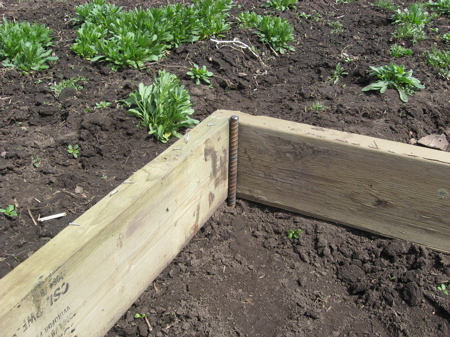
Ensure that the frame is square by measuring diagonally across it. You can temporarily keep the frame in place by pounding a 30” piece of rebar in each corner. (You can pull these out to use them in the next step.)
Step 2 – Adding the Hoops
Cut each 10’ piece of rebar into four 30” pieces of rebar. This will give you thirty-four pieces. Pound the rebar into the ground about 15” deep on the outside of your frame at two foot intervals. This will leave 15” sticking up out of the ground.
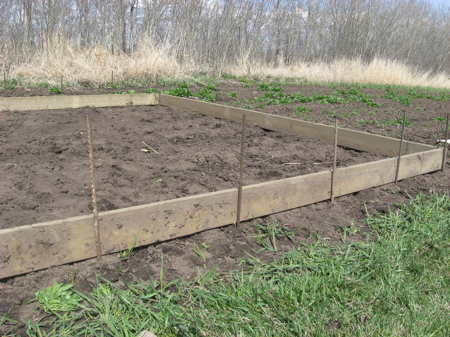
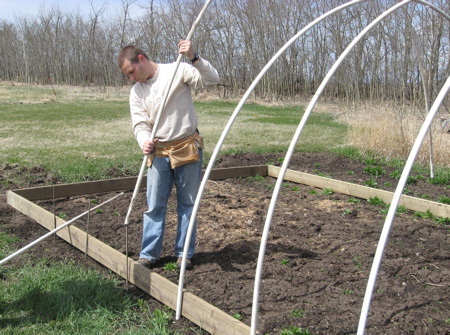
Now slide both ends of your pvc pipe over the rebar to make a hoop across the width of your greenhouse.
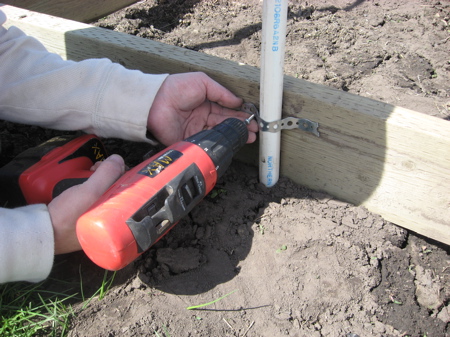
Attach the pvc pipe to the 2x6s by screwing short pieces of metal banding around the pipe.
Step 3 – Building the Ends
Cut the following pieces out of your 12’ 2x4s:
- (2) 11’8¾”
- (4) 1’6″
- (4) 4’7″
- (4) 5’7″
- (8) 1’11¼”
- (2) 4’¼”
For each end, assemble the wall according to the following diagram.
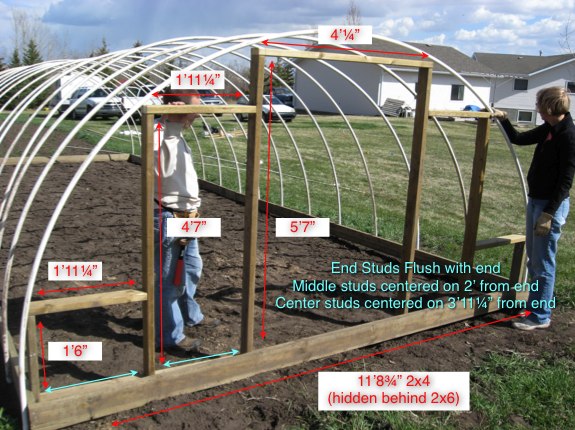
Place this wall within the 2×6 frame and nail/screw in place.
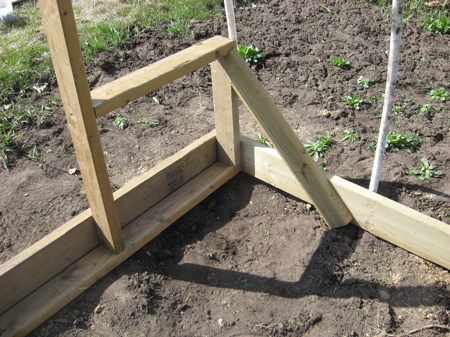
Cut (4) 28” 2×4 pieces. Cut one end at a 45º angle. Use these pieces to brace the wall.
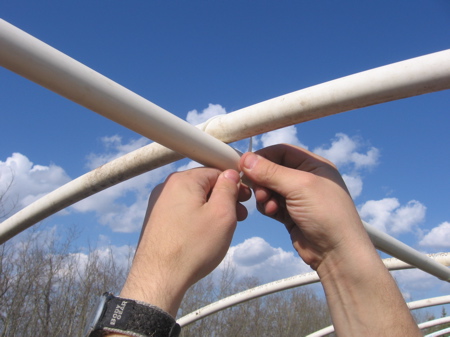
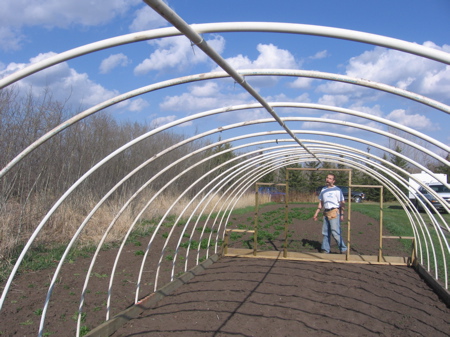
Once all of the hoops and the two ends are in place, connect two pvc pipes together and cut them to measure 32′ long. This will be the rib that will go along the top of your hoops. You can attach this rib with plastic zip ties.
Step 4 – Covering the Greenhouse with Plastic
If you are going to use wood lathe, cut 32 pieces of 20” lathe. These will secure the plastic to the sides of the 2×6 frame in between each hoop. Or optionally, you can use staples, though they may have a tendency to pull through the plastic.
Drape the plastic over the length of the greenhouse. Be sure to have enough overlap at the ends to cover the end walls. Pull the plastic snug and attach to the 2x6s at one end using the wood lathe or staples. Go to the other end, pull snug, and attach in a similar manner. Do this at the center, and then along the rest of the length of the greenhouse.
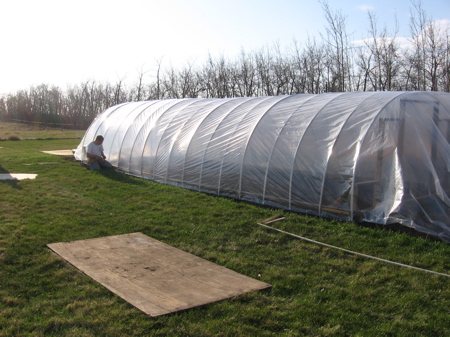
Note: If you can do this in warm weather, there will be less sagging later. Make it as snug as you can without causing damage to the plastic.
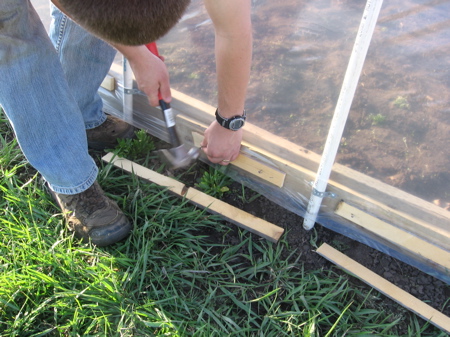
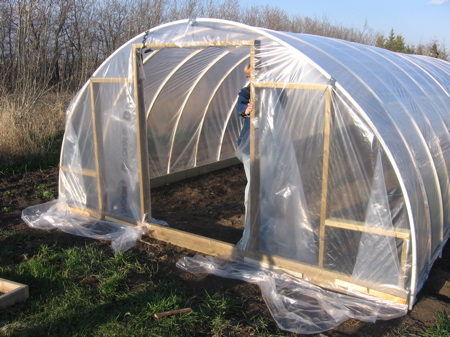
To attach the plastic to the ends, pull the plastic straight down, and attach with lathe. Then pull the plastic out to the sides. This will give you extra plastic along the outside edge. Fold the plastic back towards the center and attach. For the end with the door, cut out the plastic leaving a few inches of over hang to wrap inside and attach.
Step 5 – Adding the Door
Before you cut your pieces, check the actual measurements for the space you have. Your wall may sit a little different than mine. It’s always better to go a little small or your door may not fit. But if the measurements are the same, cut the following pieces out of your 12’ 2x4s:
- (2) 4’11”
- (2) 3’9″
Nail these together to make your door frame. Lay a 2×4 diagonally across the frame and nail in place. Trim off anything that hangs over the frame of the door. This will be on the inside of your door. Too much wood hanging over will jam your door. Attach the hinges to the door frame.
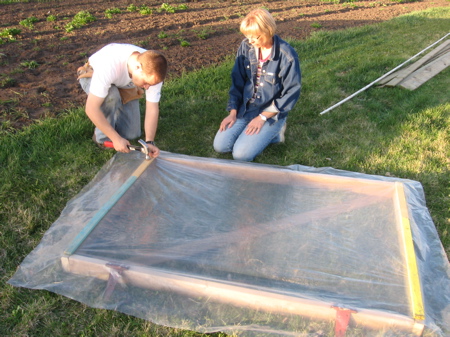
Cover the outside of the door with remaining plastic or you can use plywood if you would rather. You can attach the plastic with the wood lathe or staples. There should be about 4” of overhang of plastic on all sides.
Attach the door handles to the door. Mount the door to the frame.
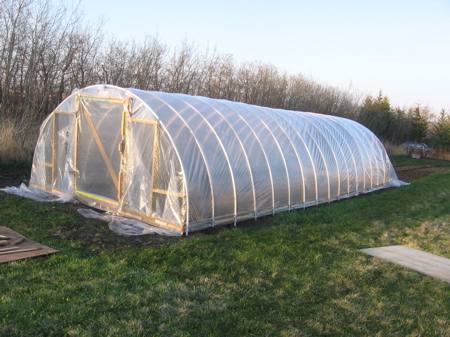
And there you go! You can have a beautiful 12’x32’ hoop-style greenhouse that can be built in a weekend and all for less than $400.
——
Update: July 11th, 2008
To see just how well this greenhouse works, see my July Greenhouse Update.
Update August 5, 2009
For an new and improved version, see An Inexpensive, Hail Proof, PVC Pipe Greenhouse.
Update November 29, 2010
Improved design. Changed material list from half inch PVC to three-quarter inch PVC.
457 replies on “How to Build an Inexpensive Hoop-Style Greenhouse”
Span-Tech Buildings Please check out our line of fabric buildings.
Hi everyone, I am going to build my hoophouse with these plans, looks realy good. One question, I live in Californis where in Feb. we still get some cold mornings and some groung fog. I grow heirloom tomato’s and start them from seed, how hard is it to keep the hoophouse warm at night, with a heater will it stay warm.
Thank’s Matt
Farmer Matt, I put a small 1500w space heater in my greenhouse on the cold nights and it keeps it about 7 degrees C. (or about 12 degrees F.) warmer than the outside temperature.
Hi Dave, where is the best place to buy the 6mm roll. I can not find one around in our area. Do you know the best place to purchase a roll, I live in Nor Cal.
Thank’s Matt
Farmer Matt,
I really can’t direct you to a local supplier for 6mm – but I would recommend checking out http://www.northerngreenhouse.com/ for 11mm – they ship out of North Dakota.
Hi Dave, I am 6ft-2in., what is the height of the greenhouse.
Thank’s, found some good deals on some 6mm film.
Matt
fantastic tutorial!!
I noticed in the material list that your design uses 1/2 ” PVC for the hoop. While most the designs from other sites used 3/4″ PVC, could you please clerify.
Thanks in advance.
David – my most recent greenhouse does have 3/4″ PVC. It probably is the better pipe to use. I’ve updated my post to reflect this. Thanks for bringing this to my attention.
Dave,
Thanks for the tutorial.
I live in Atlanta, Georgia. My hoop house is 12 by 16 for a total cost of $120 (USD). Everything was purchased from Lowes.
It is now my retreat when I need to get out of the house. The growth pattern of vegetation in the hoop house is substantial compared to outside. And this is after I gave up heating it.
Again thanks for your tutorial.
Ray – Atlanta, Georgia
just want to thank so much looked at alot of websites and not alot of if or pics then i found yours thanks for sharing your info. TO ALL WHO READ THIS IF YOU LIKE THIS IDEA ALSO CHECK OUT AQUAPONICS IT’S REALY EASY, AND A GREAT IDEA THIS GREENHOUSE WOULD BE PERFECT FOR IT. THANKS VERY VERY MUCH.
Please be mindful of the use of PVC- its manufacture creates dioxin in our environment. In Canada especially, First People have dioxin in water due to PVC manufacturing.
Please be mindful in the use of toxic and energy hog (plastic) materials.
http://www.mindfully.org/Plastic/PVC-Primary-Contributor-Dioxin.htm
LOVE your design- what is substitute for PVC?
Check it out for yourself…dioxin present in many Canadian rivers- related to plants manufacturing PVC-
Be mindful of plastics based on lots of oil production.
Reuse- recycle-
PVC is BAD idea for gardens- please research it yourself. Not environmentally safe.
Dave,
Great design. Thank for sharing. I want to make this green house but would like it about 7-8ft tall. At least in the center. Could you recommend a way to do that?
Thanks a million
Christian
Christian, as long as the pvc pipes can handle the extra stress, you can make the width a little narrower, thus making it higher.
Dave if i use ¾” x 20’white pvc pipe but pushed closer together so the hoop house will be 7′ x 32′ but a little taller than yours here. would i still need a 20′ x 50′ poly roll or could i getaway with using a 16′ x 50′ piece of poly?
Garrett, I think you would still need the full 20′ width to cover the 20′ pvc pipe.
Dave: I’ve, I’ve been biting my nails all month trying to figure out how to get myself a greenhouse that doesn’t break the bank – and I am very excited to have stumbled upon you design here. Looks good, great price. One question (I hope this hasn’t already been asked): what is the difference in day and nighttime temps in the hoophouse compared to outside? This may be hard to answer since a sunny day would probably result in much higher temps in the structure. On average though? Thanks again Dave
Ken: This is a tough question to answer. Weather, ventilation, etc… all play a part in temperature. I haven’t made an extensive study of this, but I would guess that daytime temperatures rise a good ten degrees above the outside temps. At night, since it’s not very air tight, the temperatures usually end up about the same by morning, but it takes much longer for the inside temperature to fall.
I am trying to build a hoop house with dimensions of 30’x70’…how much extra material will I need to meet those measurements?
Obafemi: If you want to go 30′ wide, you’ll probably want to go with a stronger structure than PVC. Perhaps look into steel structures?
Hey Dave, really like the hoophouse. I am going to build one similar to your design but am going to add 3′ vertical sides so I can utilize the space closer tho the sides of the house. I am going to use 1 1/2 inch PVC and was wondering how far apart, in your opinion can I space the hoops?
Dale
Dale: Good idea with the sides. That’ll give you lots more workable space. The spacing is a tough call… I’ve never tried working with 1.5″ PVC, so I’m mostly just guessing. But I might try 4′ spacing. Much more than that and I’d be afraid of snow collecting on the roof in the sags.
Thats what I was thinking 4′ should be good.
Just wondering what schedule PVC you’re using and where you find it. Home Depot in Sask doesn’t have any 20’lengths. I see coiled schedule 40 but I assume that is too flexible and expensive. Thanks.
Barb: Quite honestly, I’m not sure of the schedule. But I’m sure coiled PVC would be too flexible!
Where did you purchase the plastic covering, I am having a hard time find it?
Melissa: NorthernGreenhouse.com
That is cool. one question where is this one in the pictures
Nathanial: This greenhouse is located just southeast of Red Deer, Alberta.
Dave, you inspired me. I’m gonna build a large hoophouse but instead of covering it with plastic, we’re gonna use netting to keep the deer out. Perhaps after the Fall we’ll enclose the structure with greenhouse film. We’ll see. I do have a question for you; I’d like to make my hoophouse wider, so am considering using three 10-foot pieces of grey schedule 40 pvc piping that have a flared end to allow for easy joining of the ends. Will that work? Gonna use 1″ pipe. Will it be stable enough?
Thanks again for posting this great design and the info to go with it. You rock…!!
Alan: That should work – as the netting should have much weight. You might need some sort of angle braces. But give it a try – see how it turns out!
Dave,
I am looking into the different widths available in plastic. Do you know how wide my greenhouse can be if I go with a plastic that is 10′ in width? Thanks!
Holly: It all depends on how high you want it. 10′ wide plastic isn’t much. Perfectly round, you’d have about six feet wide and three feet tall.
Hello everyone. just got about 60 percent done with my green house but yet mine is only 12X24 and im 100 bucks on with the wood frame dirt moved and flat rebar in and pvc and fitting hooked up but i used 10 feet pvc then took a cross and combined them with a tee at the end all i need it 2×4 for the door witch im making alittle smaller and the tarp witch is 6 mil for 80 buck its 14×55 at greenhousemegastore.com i love there stuff there and i have all plant ready to go and btw i live in northern illinois rockford! it just hit 86 on sunday! highest ever in history its gunna be a good growing summer! YEAHHHH!
Dave,
Thank you for your response to my previous question. 10′ definitely will not be enough for what we want.
Could you help me out with figuring out how much plastic we need to get. I want to make sure I’m thinking of the calculations correctly.
Desired dimensions:
width: 8′
length: 16′
height: 6’5″
So, in my calculating, we would want about 16′ x 30′ of plastic….is that right?
Holly: I went to this site (http://www.csgnetwork.com/circumellipse.html) to figure out exactly how much you need. At 8′ wide and 6’6″ high, your arc would be about 17′. So in order to give yourself a bit of overhang, I would recommend getting 20′ wide. Then for your length, I would also add some for overhang – so if you want 16′ of greenhouse, buy your plastic 18′ to 20′ long.
Hi Dave –
Thanks for the response and encouragement. What do you mean by angle braces? Where would you put them? Attached to what? How large? I feel like Vinnie Barbarino… so confused! Thanks
Dave,
First of all, thank you for your previous help on questions! I do have another question though!
In your instructions above you use the wood lathe with screws or nails to secure the plastic to the greenhouse. I have seen another instruction that encourages using “wiggle wire” to secure the plastic because the plastic does not get broken in any place with those (compared to putting a nail or screw through it).
However, the wiggle wire set is going to be at least $60 and I am making my greenhouse on a budget.
From your experience, does the plastic still hold up pretty well even though you put screws through it?
Thank you!
-Holly
Holly: When I used 6 mil plastic, I did get some ripping. But since I started using 11 mil, I haven’t had an issue.
Alan: You might just have to experiment a little! I’ve braced with airplane cable, more PVC pipe, or wood. You just need to keep the structure from folding over like dominos!
Amazing and affordable Thankyou!!!!!
Hi there, I saw the plans on this site and I love it. It is simple and I think I can do it myself ( I think I might just suprise my Hubby). This will be a great project for my children (I homeschool). My question is, Can I use gray electrical pvc instead of white? Or is there a structural reason for using the white
Cally: I use the white so that the sun doesn’t heat up the pipe and weaken the plastic.
Hi again, what other material can be used to cover a green house besides plastic? Also, Is lathe a special piece of wood? or can any type of thin piece of wood be used?
I live in Alaska, and like reusing material-I am collecting old wood frame sliding door panels as everyone is changing over leaving a lot of dual pane panels 36″ wide, easy number to work with, built one two years ago-very successful and have pulled it apart to use in a larger system this fall-have 8 panels and will fill the gaps with corrugated plex and retasked windows to make moveable openings for access and ventilation. In the mean time I am trying the pvc/plastic to get past the “chill” in the air here while I renovate. I left my old set up in place over the winter here in heavy snow load and sub freeze temps and the glass survived, it was a test actually-I expected some horizontal panels would crack-they didn’t. I collected all my panels in my neighborhood, you will be surprised at whats available if you look.
We much need direction in choosing the best plastic covering for the intense Arizona sun. Regular 6 mil non-uv plastic (from Home Depot) deteriorated and fell to pieces in only 2 months of exposure. Also, some contributors point out the hazard of the PVC piping frame vapor deteriorating all varieties of plastic cover. We would like to obtain a plastic that is genuinely UV resistant and can last at least a couple of years. All suggestions are gratefully invited and welcomed.
i live in Montreal and am really having trouble to find the 20′ PVC .. So far i’ve tried Rona – Homedepot – Renot-depot – home hardware .. with no luck .. they only have 12 foot pieces. Did you use pressure PVC 3/4 inch schedule 40 or 80 ? Here (emco corp ) i can find some 3/4 pvc in 20 foot lengths but it’s all made in schedule 80 thickness .. is it going to be possible to bend this thicker pipe into a 12 foot arc ? The guy at the plumbing store that sells it ( ipex ) thinks not. What is the thickness of the PVC that you used ? Thanks great site !
Michael: I’m not really sure whether I used 40 or 80. Sorry. Might have to just try one!
To make the hoop house more wind resistant, use a length of baling twine or equivalent over each hoop (outside the plastic) except the end ones. Use a short piece of something that won’t rot (household copper wire?) around each piece of rebar and secure the the bailing twine to this to keep the twine out out of the mud. I learned this at a low cost hoop house construction project sponsored by the Western Nevada College Specialty Crop Insititure. The instructor is from Univ of Southern Utah. See “Constructing a Low-cost High Tunnel”, “illistrated web version”, extension.usu.edu/publications. This method is similar to yours but incorporates a ventilation door at each end.
Hello greenhouse is done and has tons of plants in it check out my videos on youtube username is greenhouse4green. i found a way to heat it all year long from where i am in northern illinois double do the plastic but on the inside insulate dorrs very well ply wood both ends and put a propain heater in the greenhouse and make a fan the goes between the two layers of plastic using the hot heat from the propain burner
Hi Dave,
I have enjoyed your article on the PVC greenhouse. I live in a part of Canada that most winters receives a far lot of snow and wind. Would you advise building a greenhouse 20′ wide? I would like one about 20’x60′ with plastic covering one half the length and netting covering the rest.What would be your idea for hoop spacing and the size of the tubing to support this structure. I appreciate all the comments on your site as well as your advise.
Blessings,
Peter
Peter: I would be nervous about building a 20′ wide out of PVC in a place with lots of snow. My 12′ greenhouse has been greatly bent (but not broken) by wet spring snow – I’m not sure a 20′ span could handle that much snow. You might want to look at a different type of tubing – perhaps 1′ electrical conduit or rebar? (Although I imagine that might cost a bit more.) And you would certainly want lots of angle bracing – rebar would work great for that. Another option might be an A-Frame style greenhouse. Take a look at this page for more information on that. http://www.northerngreenhouse.com/ideas/how_to/aframe.htm
I live in Ontario and would not have the room for a greenhouse of this size but would like to see if one could be made 12 feet by 15 feet. I would not heat the greenhouse in winter so I am not sure if the plastic would need to be taken off and wondered what you recommend? How easy is it to build as I am no handyman with tools. Also is attaching the plastic difficult?
Doug: I don’t heat my greenhouse through the winter either, and I leave my plastic on year-round. I would only take the plastic off if you get a heavy snow load in the winter. As to construction, it is pretty simple. If you can measure, cut, and operate a cordless drill, you’ll be fine! The plastic can be tricky, but if you have one or two people to help, it shouldn’t be a problem.
[img]https://www.albertahomegardening.com/wp-content/uploads/2011/06/brandon cam 001.JPG[/img]
This works so well. i am working gor some family friends and i built this for them they love it.
thanks for who ever desighned this
Thanks Dave. I would like to try and build the 12 x 15 size and see how I make out. It would sure give me a jump start on my veggie plants and bedding plants.
Hi brett. have you check into a website call (northerngreenhouse.com) they do carried 11 ml clear superstrong woven poly with UV resistant and it can last for years. the price is more expensive than ordinary 6ml greenhouse UV resistant plastic but the quality is well worth it. I did purchase 20’x23′ for my hoop house and it cost me $222 include GST and shipping.
I have seen a few references to using metal conduit for the hoops, but nothing as to the diameter. Is 1/2″ metal conduit too small for a 10′ wide hoop house? I have used it for smaller row covers and it seems stronger than 3/4″ pvc. Any suggestions?
Steve: I would think that 1/2″ metal conduit would be plenty strong – though I have not tried it myself.
I like you plans a lot. Well done. I plan on trying it out with a few modifications to fit my garden area. My questions is, how do plants inside a greenhouse get pollenated?
Dan: In my greenhouse I have both the back and front doors open nearly all summer. I only close them on cold spring and fall nights. Thus, there are just as many bugs & bees (maybe more) inside the greenhouse as there are outside.
Hi Dave, We’re just starting to research how to build one here in mid- Missouri and were thinking about using steel cattle panels. Do you have any ideas or feedback on this. We wanted to use stuff we already had on hand. Also not sure about how to attach 2 layers of poly and does everyone need 2 layers?
Susan: I don’t have any experience with using steel panels – but if that’s what you have, I’m sure you can make it work… I’m just not sure how. 🙂 As to the double layer of poly – it certainly helps hold the heat in. I only use one layer, but I don’t run through the winter. I just avoid those early and late frosts…
When you get it all figured out and put together, I’d love to see some pictures of how you did it!
Awesome design, any ideas on how to keep out gophers with out chemicals?
Hi Dave
How do you irrigate? I don’t believe I saw any posts on watering. I am assuming drip tape would be recommended?
Thanks
Corey
Corey: I just have a soaker hose on a timer. Drip tape would be excellent as it controls the water flow a bit better than a soaker hose.
Hello! I wanted to thank you for your great step-by-step website. We used yur basic design to build a 12′ x 16′ chicken coop. Using the PVC allowed us to make a bigger coop for the same price. We added a 3′ riser wall out of wood to protect the chicks from racoons and stray dogs and to raise the celing height for more comfort. It has really worked out great and my chickens love it! Thank you!
Hi Dave,
Thank you so much for sharing your ideas and expertise here. I have a question that I don’t think anyone else has asked. My teenage son just needs a small warm place to keep his cactus/succulent collection in the winter. (And he needs it to be VERY inexpensive) We live in the north San Francisco Bay Area, so it only gets as low as low 30’s regularly, and sometimes mid-20’s. (He actually had to keep his collection outside last winter and it survived, though not well, and he lost one.) Anyway, how small a space can be made; I mean, I have no idea how tight a PVC curve can be. Hopefully this makes sense… Thanks
Loralee: The size of your PVC pipe will determine how small an area you can make. With shorter, smaller diameter pipes, you can make a very small space. If you want something very small (like a square foot), PVC might not be the best frame. But something around 4×4 feet, would work fine with lightweight pipe.
Hello Dave and all the great people who contribute all thse nice info here… you guys sure are great and I admire all of you for doing so much for your self and the planet.
I am planning to build a greenhouse for the first time ever and I am scared that I will not be able to grow much since I do not know how to grow in a green house.
I had veggie garden for a long time when my mother was alive but I was not doing all the work so I am not sure I can grow any plans in a greenhouse by mys elf with out help from someone who know what to do and how.
I live in Wahago, between Orillia and Gravenhurs In Ontario, Canada.
Very cold here in the winter… but would love to have fresh, organic greens in the winter.
Please share with me what can I do and how and perhaps some one close to me can email me at nick@nicavita.com and so we share what we know and some how assist to get going with the greenhouse project …
I know this is a lot… but need to ask, hope I will receive answers and assistance… so I can get going and then share with all of you the results hoping will assist other in my similar situation.
Thanks in advance to you all.
Regards..
nick
Looks Great! TWO Comments. #1. The Zip Ties that you use on the top perlin should be black rather thant the white. The black is UV proof where as the white are not and will break in just a few months. #2. My Greenhouse plastic supplier told me to paint my PVC hoops with laytex paint to stop the reaction between the Plastic and the PVC. They have found that by doing this the plastic cover last much longer.
Rodney
I just had a quick question what is the inside height of this design after completion? I stand about 6’2″ and was just wondering about head room.
Thanks
Sam
Sam: My greenhouse has about 6’5″ at the peak.
That’s one fine looking greenhouse. it’s not quite that sturdy but I guess that will do in most areas where the weather is not severe. Thanks for the share!
I made one and it’s spring #2 with it. Cheap all-year fun and a great place to dream and relax. I used electrical pvc pipe and cheap poly from the local hardware store and it’s fine.
[img]https://www.albertahomegardening.com/wp-content/uploads/2012/02/DSCF1073.JPG[/img]
Brent: Looks great! Thanks for sharing the pic!
We live in Souther Alberta and went to get the supplies for this project today. Were did you get your rebar and pvc pipe, we could not find any with these lengths.
Kelly: It’s been a little while since I went shopping for this, but I’m sure at the time UFA, Home Hardware, and Co-op had it.
I really like these plans. I had almost the same idea in mind but you came up with it first in completed form. But I do see a major problem with this that I think a lot of people are unaware of. The Green Treated Wood. It leaches Arsenic poisoning into the ground and plants and make your produce toxic, especially to children. I found out about this when I read a article on kids that developed all kinds of autoimmune and brain damage all of the sudden in this one family. The garden was right next to the kids large outdoor tree house play set that was made with this Green treated wood for part of the set and the outside framing on the ground to hold all the gravel in one place. After testing they found that the cause of the arsenic poisoning was the pressure treated wood. I myself have MS from working with a chemical soup and most of them where solvents. People do not realize how much dangers there really are in their environment because they think the government agencies are protecting our health. Far from it. They are only protecting large companies and industries while people are dying because of the lack of real protections.
Sorry I meant to add that I like the idea of Cedar or Redwood for that matter and you can get some thick black poly plastic at Home Depot online to cover the wood and insulate it on the inside of the green house also. It does not leach if it does not get wet. Also that is where I am getting the 6 mil clear poly plastic and you can buy it in 20′ x 100′ if you want to double the length of the plans here. Hope you all have a safe 100% organic produce growth with this extra knowledge. One other thing. The soil has to be safe and 100% organic also. If it says natural or just organic and not 100% Organic then you are in for trouble as they have in some soils chemicals and shredded tires which leach toxins into the soil and plants and produce. Your foundation is your soil and if chemicals or any kind of toxins are in it or leach into it then the plants will become toxic themselves. So if you plan on using plants to filter the toxins themselves like in a Earthship home I would first run the water through non-edible plants with roots that filter the water then any other types of filters such as a horse manure reservoir that has enzymes in it that destroy almost any chemicals before the water leaches all the way through to the other side of the large wall of horse manure. The best way to water your plants is catching rain water in a large water cistern and my idea was to make a river rock bed gutter with the excess plastic the full length of the green house on each side. The river rock is to work as a anchor for the plastic inside the ground level gutter. That way the weather can never blow it up and away. This way the green house is also your water catch surface. Instead of wood lath at the bottom I would use plastic there also since it is going to get wet and again avoid toxic woods for framing and etc. I was going to use a foot high of earth bags for the bottom framing and at the ends build a pvc frame work with a pvc door and windows. You can take larger diameter PVC and slice out section the length of it so that it is still more than half of it in the diameter the full length of it left then use it like a clip to lock to plastic over the PVC framing. Also like he did here the full length overhead on the inside with a long piece of PVC I would do the same every couple feet down the sides on the inside with more full length PVC and use stainless steel wire from Harbor Freight. (They sell it in 0.041″ SS Lock Wire in a plastic case and it is a 1 lb coil.) I use that wire like McGuyver uses duct tape. You can drill little fine holes in the loop framing and push that wire through to hold the long PVC on the sides inside the framing. Sorry I do not have any pictures to show you of what I am saying here because I have not built mine as of yet. That SS Lock wire is only about $6 USD for a pound I do not know but it would only take a couple pounds I am guessing to make ties out of this. I would also drill fine holes on the full length pieces so the loop frames will not slip or shift on them also. That way you can make sure your spacing on the loop frame is perfect and never shifts even in the strongest of storms and this will give the whole structure much more strength to withstand more weather abuse and even a snow load that is not too heavy. Oh and for interior heating in the winter. Have a compost pile at one end or in the center at at one end and that should put off heat during the winter months. Another thing making this sturdy enough makes it so you can easily have a vertical garden in this green house and it will more then triple your produce output. You can water starting from the top and let it work its way to each level till it gets to the bottom then have tanks to filter soil out and and even grow fish in. One guy on YouTube did that: http://www.youtube.com/watch?v=jV9CCxdkOng
Have fun!
Love your plans for a greenhouse. I am building a small 6 ft square greenhouse with a 6 inch slope to the roof out of 1 inch pvc pipes. I have rolls of this really heavy gage tinted vinyl that is used to be adhered to windows for insulation from the sun that I plan to sew together into sheets to cover my greenhouse. This vinyl is designed to keep a house cool in summer and warm in the winter. I live in Central Florida where we only have occasional deep overnight freezes for maybe 5 to 6 hours during the winter. I want to start vegetable seedlings early in it. Is there an inexpensive way for me to heat it given the small area and type of covering that I plan to use? I’m on a fixed income and don’t have a lot of money to play with. If I were to use high wattage lamp, would that be sufficient in that small space?
Misty: I would think that a heat lamp in those conditions should be plenty to keep it above freezing.
Coouldnt you use a small space heater to heat that litlle area. Im sure it would work VERY well!
Misty, another cheap way to heat a greenhouse in a place like Florida is to use water. You can find square containers used to keep cooking oil for restaurants that hold approximately 5 Gals. Fill them with water and let them absorb heat during the day inside your greenhouse. At night they will give off some heat.
Vinyl is not as durable as the 6 Mil Poly wrap used for tarps at Home Depot if you ask me?
my school is proposing to build a green house. would this be a good and inexspensive way to go about things
-Dani
porter high school, Porter TX
Dani: I think this would be a great, inexpensive greenhouse for your school! Go for it!